
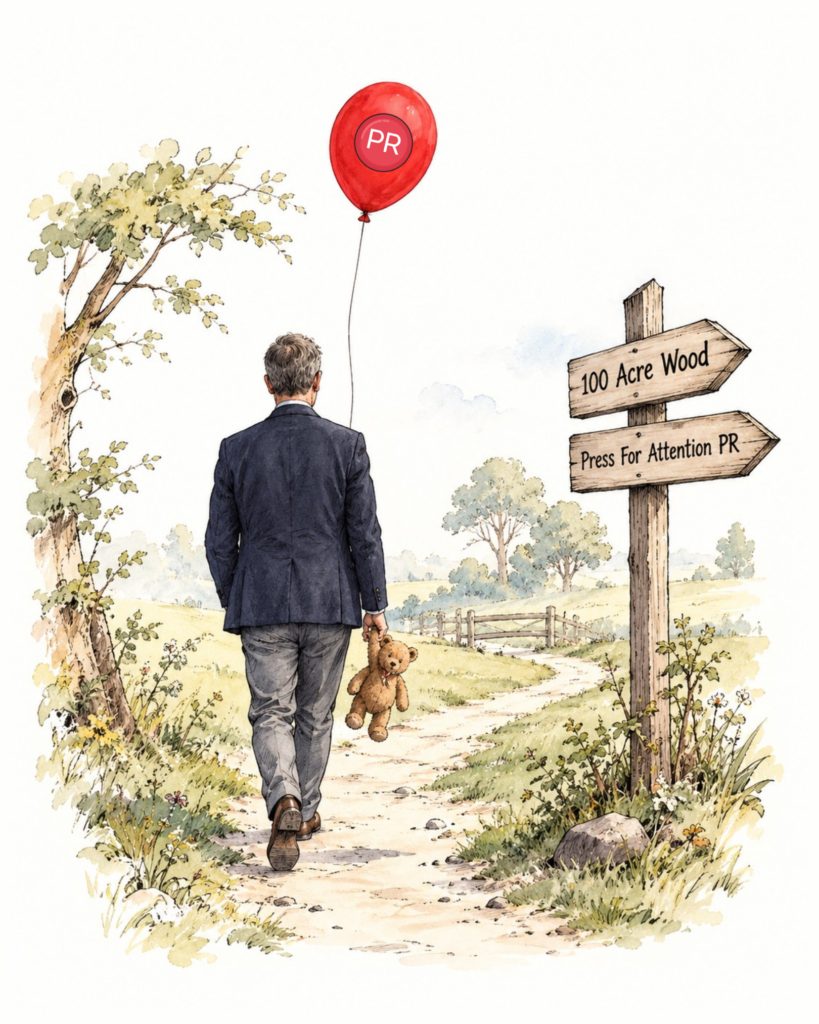
Yesterday was a Very Important Day. Unfortunately, I missed it.
Not entirely, you understand. I knew there was something important happening. I had that peculiar feeling one gets when one has forgotten something, but can’t quite remember what it was one was supposed to remember. Which, for a PR man, is rather unfortunate.
You see, yesterday, 14 October, Winnie-the-Pooh turned 100.
One hundred years since A. A. Milne first introduced the world to a bear of very little brain, a fondness for honey and an extraordinary ability to get himself into trouble without ever really meaning to.
And there I was, a day late. “Oh, bother,” I thought.
Although, on reflection, I suspect Pooh would have been quite understanding. Birthdays are Important Things, certainly, but so are breakfast, elevenses and finding out whether there is any honey left in the cupboard.
And sometimes a bear, or indeed a PR man, simply has to get his priorities in order.
But the more I thought about it, the more I realised something rather interesting.
For a bear of very little brain, Pooh has been running a remarkably successful PR campaign for a hundred years. And I, who have spent rather a lot of my working life helping people get noticed, thought I ought to investigate. So I did.
In which we discover that being clever isn’t everything.
The first thing to understand about Pooh is that he isn’t terribly clever. He would be the first to admit it, if he could remember what it was he was admitting.
He doesn’t have a five-year strategic growth plan. He doesn’t spend his evenings polishing his LinkedIn profile. And I rather doubt he has ever attended a webinar on thought leadership.
Yet almost everybody knows who he is. Which is more than can be said for a great many businesses with considerably larger marketing budgets.
You see, Pooh knows what he stands for. Honey. Friendship. A little adventure, provided it doesn’t interfere with lunch. He doesn’t try to be anything else.
And there’s a lesson here for businesses who spend their days describing themselves as innovative, dynamic, customer-centric providers of bespoke solutions.
Which is a rather long way of saying absolutely nothing.
Pooh is memorable because Pooh is Pooh. And that, as it turns out, is rather good branding.
In which we meet some familiar business personalities
Of course, Pooh doesn’t live in the Hundred Acre Wood alone. There’s Tigger, who is terribly enthusiastic about absolutely everything, including things he hasn’t properly understood. We’ve all met a Tigger at a networking event.
There’s Rabbit, who likes Plans and Procedures and would almost certainly insist on a meeting before allowing anyone to do anything.
Owl knows a Great Deal about a Great Many Things. Or at least he believes he does, which isn’t always quite the same thing.
And then there’s Eeyore. I have met Eeyore at business networking events too. Usually standing by the coffee machine explaining why PR won’t work for his particular industry.
The wonderful thing about these characters is that we know them immediately. They have personalities. Flaws. Opinions. Little peculiarities that make them interesting. And people remember interesting people.
Which is why I spend so much time telling business owners to stop hiding behind their logos and start showing the personalities behind their businesses.
Nobody ever fell in love with a corporate mission statement. Although Rabbit would probably insist on having one.
In which the story becomes rather more complicated
Now, not everything in the Hundred Acre Wood is quite as cheerful as it first appears. And this is where our little expedition takes a more serious turn.
Because behind the fictional Christopher Robin was a real little boy. And behind that little boy was a father who had written one of the most successful children’s books of all time.
If you’ve seen the film Goodbye Christopher Robin, you’ll know that the story behind the story is rather more complicated than a bear and his friends having adventures in the woods.
The film explores the pressures placed on the real Christopher Robin as his father’s creation became a publishing sensation.
There were photographs. Public appearances. Enormous interest in the boy who had inspired the books. And parents who, in the film’s telling, became caught up in the extraordinary success of it all.
The real Christopher Robin would later describe the difficulties of growing up in the shadow of his fictional namesake.
Imagine that for a moment. Your childhood becomes one of the most beloved stories ever told. The whole world knows your name. But somehow, the story no longer feels entirely yours.
As a PR man, I find that fascinating. And rather sad. Because while I spend much of my time encouraging entrepreneurs to tell their stories, there’s an important distinction between sharing your story and surrendering ownership of it.
Publicity can open doors. Build businesses. Change lives. But it can also place enormous pressure on the people caught up in it.
And sometimes, in our enthusiasm to create a Great Big Story, we forget to ask whether everybody involved actually wants to be part of it. Especially the children.
It’s worth remembering that Goodbye Christopher Robin is a dramatisation rather than a documentary. But the uncomfortable questions it raises about fame, family and the ownership of a story are very real.
Even in the Hundred Acre Wood, there are lessons that aren’t quite so sweet as honey.
In which a bear discovers the secret of staying famous
Now, a hundred years is a very long time. Longer than most businesses last. Longer than most marketing campaigns. And considerably longer than the average social media trend, which these days seems to last until approximately Thursday lunchtime.
Yet Pooh is still here. He’s survived changing fashions, new technologies, television, cinema and the arrival of a certain mouse with a rather impressive marketing department.
Disney, of course, has helped turn Pooh into a global commercial phenomenon, and the centenary has provided another opportunity for campaigns, collaborations, products and celebrations.
But here’s the clever part. Pooh hasn’t really changed. He still likes honey. He still worries about his friends. He still approaches life’s little difficulties with a mixture of optimism, confusion and a surprising amount of wisdom.
The world around him has changed enormously. But the thing that made people love him in the first place remains. And I think there’s something rather Important in that. Businesses are forever being told to reinvent themselves.
New platforms. New trends. New marketing strategies. New ways to get noticed. And certainly, we must adapt. But we shouldn’t be so busy chasing the next shiny thing that we forget what made people care about us in the first place.
Sometimes the best marketing strategy is to remember who you are. And then remind everybody else.
In which I realise I have made a rather embarrassing mistake
Which brings us back to yesterday. Because anniversaries, as any reasonably competent PR person will tell you, are wonderful opportunities.
They provide a reason to tell a story. A reason to look back, celebrate achievements, reflect on lessons learned and perhaps make a little noise about what happens next.
Five years in business. Ten years. Twenty. Your first customer. Your thousandth order. The day you took a chance on an idea that everybody else thought was rather silly. All potentially excellent stories.
And here was Winnie-the-Pooh, sitting on a hundred years of history, and I managed to miss the actual birthday.
Which is a little embarrassing for someone who literally runs a business called Press For Attention PR. Still, perhaps there’s a lesson in that too.
You see, while the best time to tell a story might have been yesterday, the second-best time is often today.
Provided, of course, that you’ve still got something worth saying. And Pooh, after a hundred years, most certainly has.
In which we come to a rather Thoughtful Conclusion
So what have we learned from our little visit to the Hundred Acre Wood?
Well, being memorable is more important than sounding clever. Having a personality is considerably more useful than having a collection of corporate buzzwords.
A good story can last a very long time indeed. And publicity, while a Wonderful Thing when handled properly, should never come at the expense of the people behind it.
Which brings me to one final thought. For a hundred years, Winnie-the-Pooh has reminded us of the importance of friendship, kindness and appreciating life’s simpler pleasures. And perhaps that’s why we’re still talking about him.
Not because he was the loudest bear in the wood. Not because he had the biggest marketing budget. But because people cared about him. And in PR, that’s a rather powerful place to be.
So, happy birthday, Pooh. I’m sorry I’m late. I was busy thinking, thinking, thinking. Which is all very well, but next time I really must put it in the diary.
Now, if you’ll excuse me, I think it’s time for a Little Something. Preferably involving honey.