
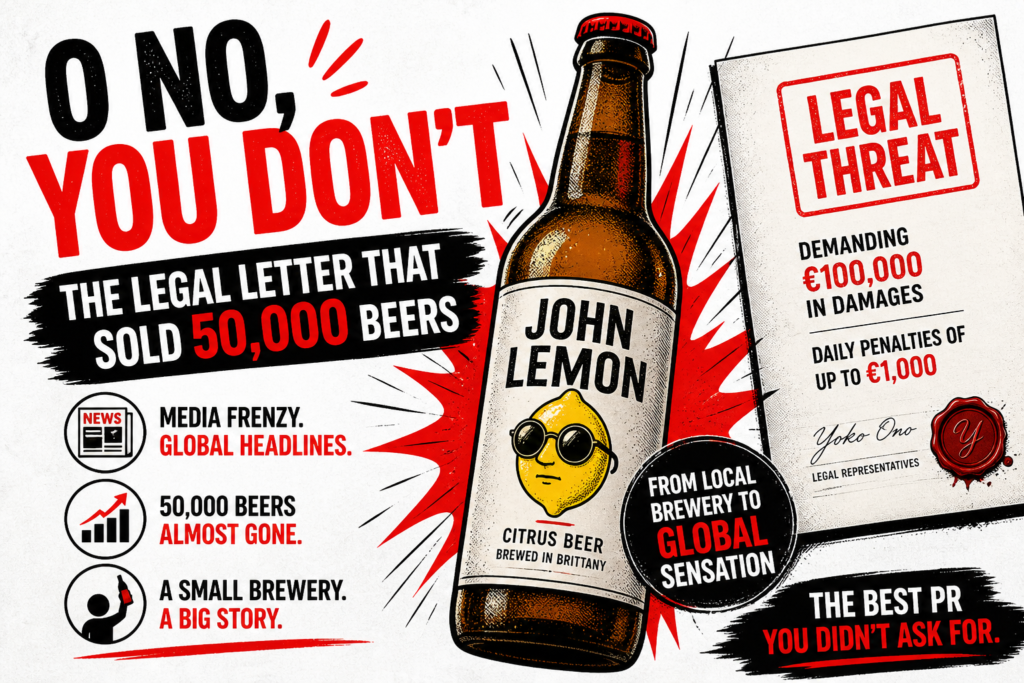
The legal letter arrived, and with it came the kind of panic most small business owners would recognise instantly.
What followed, though, was something else entirely.
Because after the initial shock came the headlines, the search traffic, and the customers. Nobody planned it, nobody budgeted for it, but the backlash did what years of steady marketing hadn’t managed to achieve.
A small brewery in Brittany had been selling a citrus beer called “John Lemon” for around five years. It was a modest, local operation, shifting roughly 50,000 bottles a year within a 40-kilometre radius. The kind of business that ticks along nicely without troubling anyone.
Until it did.
Lawyers acting for Yoko Ono stepped in, demanding €100,000 in damages and threatening daily penalties of up to €1,000.
Production had to stop, stock had to be recalled, and everything had to happen immediately.
For a business with two employees and just 5,000 bottles left, this wasn’t a minor inconvenience. It was the sort of moment that can end a company.
To their credit, they negotiated a small window to sell the remaining stock before a July 1 deadline. On its own, that might have been the end of it. A quiet wind-down, a frustrating lesson, and a story told over a pint or two.
But then the media got hold of it.
At that point, the situation shifted from a legal dispute into something far more powerful. It became a story people instinctively understood. A small, independent brewery up against the legacy of John Lennon. A playful pun colliding with the realities of intellectual property law. David versus Goliath, told through the lens of a beer label.
Within days, they had sold almost everything, with fewer than 1,000 bottles remaining.
The owner, Aurélien Picard, captured the tone of it perfectly when he said it was “kind of funny, amid our misfortune.” That balance, between genuine risk and quiet humour, is part of what made the story travel.
The impending ban created urgency. People wanted to get hold of the beer before it disappeared. The underdog narrative made it easy to share, and the absurdity of the situation gave it that extra edge that makes people stop scrolling and pay attention.
What had been a regional product suddenly became a collector’s item. The coverage went international, consumer sympathy kicked in, and a routine stock run turned into something resembling a cultural moment.
Crucially, none of this was orchestrated. There was no clever PR plan sitting behind it, no campaign designed to provoke a reaction. The brewery simply found itself at the centre of a collision between a global legacy brand and a local product, and the story did the rest.
Even the attempted rebrand added fuel to the fire. Picard’s suggestion of “Jaune Lemon” was rejected by the same legal team, which only served to extend the life of the story and bring another wave of attention.
It would be easy to look at this and conclude that controversy is the answer, that provoking a reaction is somehow a shortcut to visibility.
But that misses the point.
If this had been engineered deliberately, it would almost certainly have fallen flat. People are quick to spot something that feels manufactured, and the charm of this story lies in the fact that it wasn’t. It felt real, slightly chaotic, and completely out of the brewery’s control.
What made it work was the tension. A small business minding its own affairs ran straight into a name that carries decades of cultural weight, and the response was inevitable. That clash created something people wanted to talk about.
You can’t plan for that kind of moment, but you can recognise why it cuts through when it happens.
In a world where most marketing is carefully constructed and often ignored, stories like this stand out because they don’t feel like marketing at all. They feel human, imperfect, and just a little bit ridiculous.
And when that happens, the story does what the budget never could.
Sometimes, the best PR you’ll ever get is the kind you didn’t ask for.
Greg