
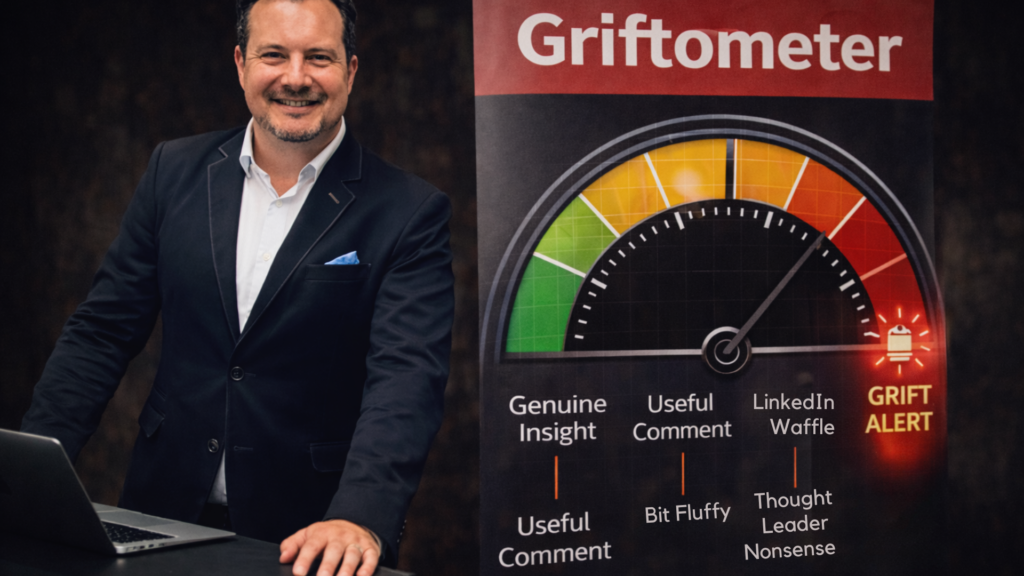
PR guru launches ‘Griftometer’ to help journalists filter spam, bots and bogus experts
Press For Attention PR marks 18 years in business with new system designed to separate genuine expertise from inbox clutter
A Nottingham-based PR agency has unveiled a new system designed to help journalists and editors cut through the growing volume of low-quality outreach, spam and so-called “expert” commentary now flooding their inboxes.
Press For Attention PR, founded on April 1st, has launched what it calls the Griftometer™ — a proprietary tool that analyses incoming commentary, pitches and expert opinion to assess credibility, relevance and likely usefulness to the media.
“This isn’t about AI,” said founder Greg Simpson. “Used properly, AI is a brilliant tool. This is about the rise of mass-produced ‘expertise’ — content that looks the part, sounds convincing, but ultimately says very little and wastes people’s time.”
“At this point, we’re less concerned with who is using AI — and more concerned with who is using it to pretend they know what they’re doing.”
Developed using insights gathered over 18 years working with journalists and business owners, the Griftometer is designed to identify patterns commonly found in low-quality outreach and over-polished commentary.
According to the agency, the system evaluates submissions based on a number of key indicators, including relevance to the story, specificity of insight, originality of thought and what it describes as a “would anyone actually use this?” score.
It also flags a number of classic warning signs.
These include commentary that could apply to virtually any industry or news story, overuse of vague claims such as “disrupting the space” or “passionate about innovation”, and a lack of real-world examples or lived experience.
The system is also said to detect “buzzword density”, cliché frequency and what Simpson describes as “suspiciously perfect grammar paired with zero personality”.
Other triggers include quotes that appear to have been written without ever speaking to the person being quoted, and expert commentary that reads more like a LinkedIn post than a useful contribution to a news story.
Additional indicators include commentary that begins with “In today’s fast-paced world…”, experts who are “excited to share their thoughts” on topics they’ve never publicly commented on before, and pitches that promise “unique insight” before delivering recycled opinion.
“We’re not short of experts,” Simpson said. “We’re short of ones worth quoting.”
He added: “AI hasn’t created the problem. It’s just made it scale. It’s never been easier to sound credible — and never been easier to spot when someone isn’t.”
The launch comes amid growing concern among journalists about the volume of generic, untargeted and often automated outreach, with inboxes increasingly filled with templated commentary and recycled opinion.
“Journalists don’t need more content,” Simpson said. “They need better sources. They need people who actually have something to say — and can say it in a way that’s worth publishing.”
While the Griftometer is presented as a system, Simpson admits its foundations are less about technology and more about experience.
“After 18 years, you get a feel for this stuff,” he said. “You know when something’s been written to sound good, and when it’s been written because it is good.”
“Most of what the Griftometer flags isn’t wrong,” he added. “It’s just not worth anyone’s time.”
The agency confirmed that the Griftometer will be made available to journalists and content creators looking to filter credible expert commentary from inbox noise.
Alongside the launch, Press For Attention PR will continue to offer its AI-powered ‘Dr Spin’ tool, which provides founders and business owners with access to proven PR thinking and idea development support.
“Dr Spin can help you shape your thinking,” Simpson said. “The Griftometer helps make sure it’s actually worth sharing.”
For those looking to build genuine authority — rather than simply sound like they have it — Press For Attention PR recommends speaking to the team directly.
The technology behind the Griftometer remains under wraps, although sources suggest it may rely heavily on experience, instinct and a low tolerance for nonsense.